
Reviewed · ZAGREB OLD & UPPER TOWN WALKING TOURS
Private Walking Tour in Zagreb with Local Guide
Zagreb gets personal on a private walk. This tour uses the city center’s earthquake-era scaffolding to tell stories you can feel, not just read, with a local guide and a mobile ticket. I love how the route connects identity landmarks like the Cathedral of Zagreb with daily street life at Dolac Market and Tkalčićeva Street. I also like the way it keeps you moving through the medieval Upper Town, down to places like Petrini Pyli and the Tunel Gric story. One consideration: it’s mostly walking, and the hill is steep—especially if you skip the funicular.
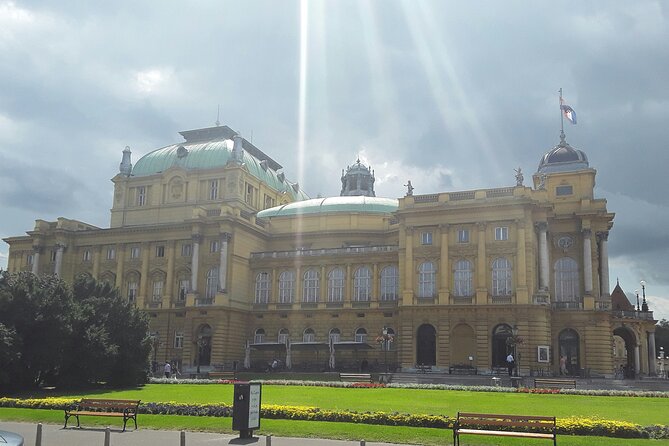
If you’re lucky with timing and guide, you’ll get serious narrative energy. Past groups were guided by people such as Samra, Samia Zitouhni, and Spomenka Sabic, and the common thread is clear: expect history that sounds like conversation, plus answers that actually match what you ask. The last stop lands near the Croatian National Theatre, so you finish with a natural transition into coffee and wandering on your own.
Here’s the practical catch: all the listed sights have admission noted as free, but the funicular has an extra cost. The guide gives you the choice—ride or walk down the stairs through a hidden park—so you can match the experience to your fitness level.
In This Review
- Key things to know before you go
- Zagreb’s Cathedral-to-Tunnel Route Feels Real After the 2020 Quakes
- Meeting at Ban Jelačić Square: How the 1.5–2 Hour Pace Works
- Stop 1: Zagreb Cathedral at Kaptol (Free, and a Big Identity Marker)
- Stop 2: Dolac Market for Local Food Senses, Not Just Photos
- Stop 3: Tkalčićeva Street and the Social Life of Zagreb
- Stop 4: Petrini Pyli (The Stone Gate) for Medieval Atmosphere
- Stop 5: Upper Town Gornji Grad—Hierarchy, Politics, and the Middle Ages
- Stop 6: St. Mark’s Church and the Community Square Naming Trick
- Stop 7: The Funicular Railway—Ride or Walk Down the Steep Stairs
- Stop 8: Tunel Gric—Fairytale or Nightmare, Then the Truth
- Stop 9: Square of Petar Preradović—Where Names and Daily Life Collide
- Price and Value: Why $28.92 Can Feel Fair for a Private 2-Hour Walk
- Who This Tour Suits Best (And Who Might Want to Adjust)
- Should You Book This Private Zagreb Walking Tour?
- FAQ
- How long is the private walking tour?
- What does the tour cost?
- Is this a private tour or a group tour?
- Do I need tickets for the stops?
- Where do we meet?
- Where does the tour end?
- Is there a physical fitness requirement?
- Are service animals allowed?
- Is the meeting point near public transportation?
- What is the cancellation policy?
Key things to know before you go
- Earthquake storytelling in the city center: Two strong 2020 quakes left many central buildings under scaffolds, and the walk uses that as part of the city’s real-life story.
- Private group only: It’s your group, not a shared bus-style experience.
- Free admission at most stops: The tour lists free admission for every stop except the funicular.
- Optional funicular down the hill: Use it if you want; skip it if you’d rather walk.
- A route that mixes famous landmarks with local life: Cathedral views, market smells, social streets, and medieval stonework.
- Tunel Gric adds a twist: You’ll hear impressions first, then the truth behind the place.
Zagreb’s Cathedral-to-Tunnel Route Feels Real After the 2020 Quakes
Zagreb can look like a postcard from the Upper Town, but this walk treats it like a living city with scars and recovery. In March and December 2020, Zagreb was hit by two strong earthquakes, and a lot of the city center buildings still sit under scaffolds. Instead of avoiding that, the guide folds it into the story of the people and the country.
I like this approach because it makes the city feel present. You get to see the landmarks—like the Cathedral of Zagreb—while also understanding that history is not just centuries-old; it’s also what’s happening right now and how people adapt. If you care about how places survive change, this tour gives you that lens without turning it into a lecture.
You’ll also notice the “human scale” of the route. The itinerary is short enough to stay lively, but detailed enough to bounce between identity landmarks and everyday hangouts, like Dolac Market and the social street Tkalčićeva. That mix is part of the value: you don’t just collect sights, you collect context.
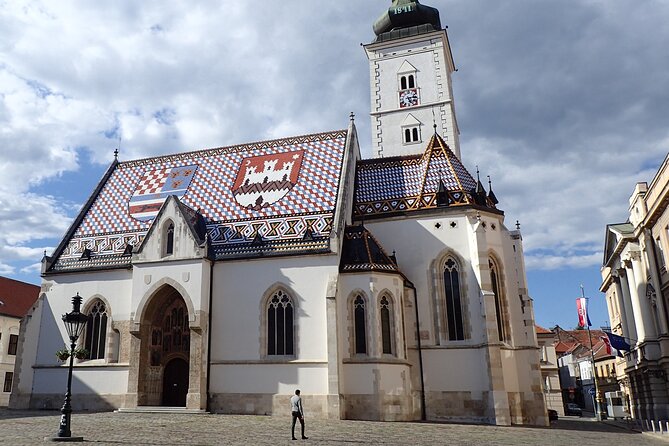
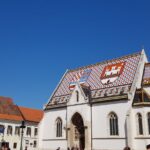
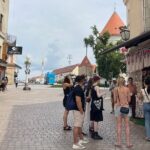
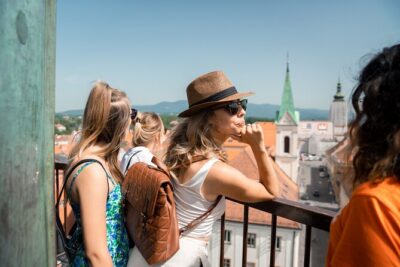
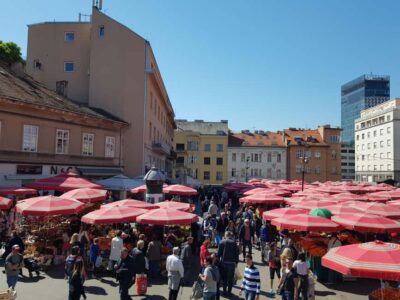
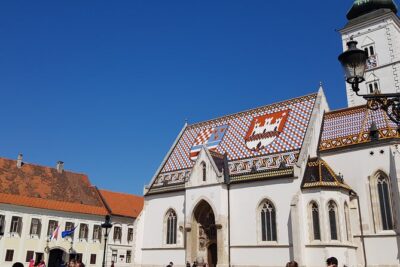
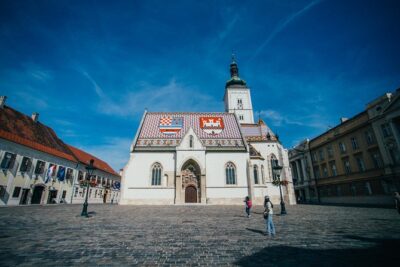
More walks through the Upper Town, St Mark's roof and the Dolac stalls below.


Meeting at Ban Jelačić Square: How the 1.5–2 Hour Pace Works
The tour starts at Ban Josip Jelačić Square (Trg bana Josipa Jelačića) in Zagreb’s Gornji Grad – Medveščak area. The finish is near the Croatian National Theatre in Zagreb (Trg Republike Hrvatske 15).
The total duration is about 1 hour 30 minutes to 2 hours. That time window matters because it usually fits nicely into a first-day schedule. If you arrive by transit that morning or afternoon, you can still do this walk without feeling like you’ve lost your whole day.
It’s also set up for moderate physical fitness. This is not a flat stroll. You’ll be on slopes around the Upper Town, and you’ll be making decisions about stairs and views. The tour gives you that flexibility later at the funicular stop, but the “steepness reality” is there from the start.
Stop 1: Zagreb Cathedral at Kaptol (Free, and a Big Identity Marker)
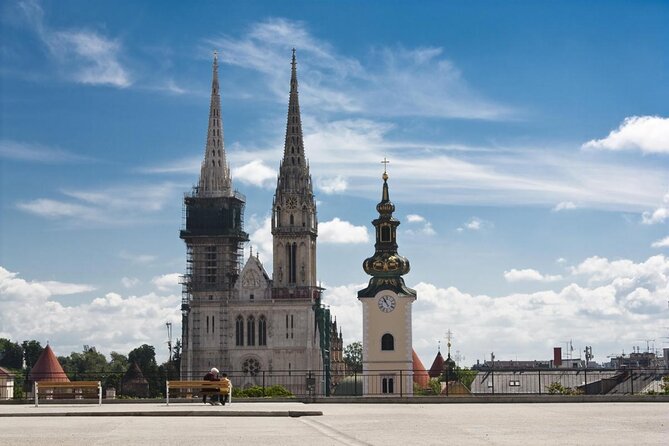
Your first major checkpoint is the Cathedral of Zagreb, at Kaptol. The tour frames it as more than a church. For many Croatians, it’s an identity landmark—one of those places you can’t really understand the city without.
What you’ll get here is a sense of why the cathedral belongs at the beginning of the route. The guide uses it to set themes: belonging, hierarchy in medieval times, and how religious buildings helped organize community life. It’s also a great early stop because the area gives you an immediate orientation for the Upper Town.
Admission is listed as free, so you won’t waste time worrying about tickets for this first moment. If you’re photo-minded, arrive with one mindset: think less about a perfect picture and more about noticing what the building represents when you look at it from different angles.
More days out with a guide who knows the city.
Stop 2: Dolac Market for Local Food Senses, Not Just Photos
Next is Dolac Market, where you can pause for about 10 minutes. The tour idea here is simple: slow down and sense the place—smell, color, and the fact that locals buy seasonal food here, not just tour groups.
This stop is valuable even if you don’t plan to eat. Markets are where cities show their rhythm. They tell you what’s available, what’s valued, and what people do daily. You also learn how a market sits inside a bigger neighborhood story, instead of being a random stop on a sightseeing list.
Admission is noted as free, and that’s helpful because it lets you treat the market as a genuine break. If you want to buy something, you’ll have time, but the main win is the context your guide gives while you’re there.
Stop 3: Tkalčićeva Street and the Social Life of Zagreb
Then you head to Tkalčićeva Street, a central social street in the city. The tour points out that even though this street feels established now, it didn’t exist here not so long ago—so it’s a lesson in how cities rewrite themselves.
The stop also gets framed around social life: where people gather, how coffee culture fits into the day, and how street life reflects Zagreb’s bigger timeline. It’s one of those spots where you can watch, then understand. You’ll feel the street’s energy as you walk, but your guide helps you read what that energy means.
Time here is about 10 minutes, admission free. Practical note: if you visit when there’s holiday activity or special events in town, this street can be busy. That’s not a problem, just plan to stay flexible and accept the city as it is.
Stop 4: Petrini Pyli (The Stone Gate) for Medieval Atmosphere
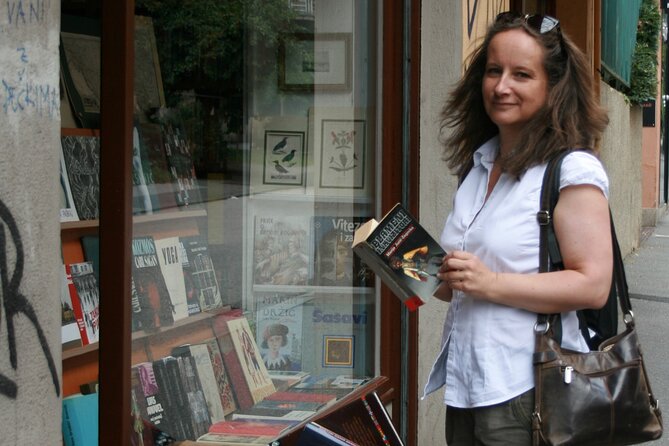
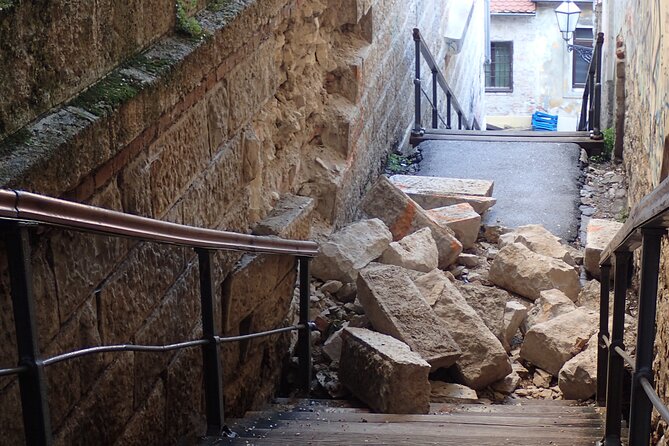
At Petrini Pyli, also known as the Stone Gate of Zagreb, you get a short stop—about 5 minutes—but it’s set up to be memorable. This is described as a special public place where medieval spirits hide.
I like this because it breaks the pattern of only big monuments. A stone gate is small enough to miss if you’re not paying attention, but it’s powerful because it marks movement: entry, passage, and boundaries. When a guide points out how these structures fit medieval life, you start seeing Zagreb’s old logic in the layout, not just in the buildings.
Admission is listed as free, so it’s a quick “worth it” pause. Keep your eyes up: stonework and street corners usually reward slower attention.
Stop 5: Upper Town Gornji Grad—Hierarchy, Politics, and the Middle Ages
Now you move into Gornji Grad (Upper Town), around 20 minutes. The tour compares the historical hierarchy, noting that Kaptol with the cathedral was higher in importance, even if it wasn’t higher by sea level. That’s a smart detail because it reminds you: “importance” doesn’t always follow elevation.
The Upper Town portion also connects the area to political life in the Republic of Croatia. The guide’s job here is to help you see the Middle Ages hiding in plain sight—how older systems shaped the shapes you walk through today.
If you want a fast mental model, it’s this: medieval power organizes space, and later political life reuses parts of that space. The walk keeps pulling you back to how Zagreb’s present sits on top of earlier organization.
Admission is listed as free for this stop, which helps keep the momentum. Just be prepared for more uphill walking and a few turns where the views suddenly make sense.
Stop 6: St. Mark’s Church and the Community Square Naming Trick
Next comes St. Mark’s Church in the Upper Town area. The guide makes an interesting clarification: the saint patron of the Upper Town is not St. Mark, but the main medieval square and main community church are called after another saint—St. Mark.
That naming detail is exactly the kind of thing that makes a guide worthwhile. Without it, you might assume a simpler origin story. With it, you start noticing how labels and traditions can shift while people keep using the same focal points.
Time here is about 10 minutes, admission free. This is also a good pause to ask questions. If the tour pace feels fast, this is where clarifications land best: people usually get the most engaged when the story turns from buildings to how communities think about themselves.
Stop 7: The Funicular Railway—Ride or Walk Down the Steep Stairs
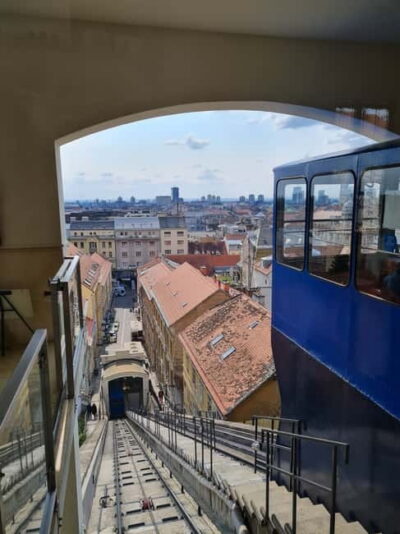
Here’s where you get a real choice: the Funicular Railway. The tour explains that the decision depends on your fitness level and willingness to walk down. You can either:
- Cut it short using the funicular, described as the shortest funicular in the world, with a cost mentioned as 5 Kunas per person in 2021 (so you’ll want to accept that prices may have changed), or
- Walk down the steep stairs through a picturesque hidden park.
A practical tip: if you’re traveling with mixed fitness levels in your group, the funicular option often keeps the energy up and protects your legs for the rest of the walk. If you’re feeling good and want more scenery time, walking is a nice way to slow down and notice greenery and angles you’d miss from the ride.
The funicular ticket is not included in the tour. Everything else listed is noted as free admission, so this is the only “budget moment” where you’ll likely pull out your wallet.
Stop 8: Tunel Gric—Fairytale or Nightmare, Then the Truth
At Tunel Gric, you get about 10 minutes with a story built around impressions first, then explanation. The tour frames it as a fairytale or a nightmare—then promises you’ll learn the truth.
This stop is useful because it teaches you how to “read” a place like a local story. You’re not only looking at an object or an entrance; you’re learning why people talk about it the way they do. That’s a strong travel skill, and it transfers after the tour, too. Even when you’re sightseeing alone later, you’ll likely catch more meaning.
Admission is listed as free here, so don’t expect a gate or a separate ticket step. Just show up with curiosity, and let the guide guide.
Stop 9: Square of Petar Preradović—Where Names and Daily Life Collide
The final stop is the Square of Petar Preradović, a quick 5 minutes stop. The tour shares a fun local detail: if you ask a local citizen for directions, they might not know what you’re talking about because locals call it something else.
That’s not just trivia. It’s a reminder that maps and official labels don’t always match everyday speech. Finishing here is a good way to help you understand Zagreb’s living language—how people talk, what they notice, and how places are referenced through habit.
The tour also contrasts this square with Tkalčićeva, describing both as main stages for the city’s social life and coffee culture, plus a sense of elite passing by. Even if you’re not chasing that scene, you’ll likely enjoy the final atmosphere: you’re ending near the point where your own wandering can start.
From here, you finish near the Croatian National Theatre, which is a convenient landmark for taking photos, catching transit, or continuing on foot.
Price and Value: Why $28.92 Can Feel Fair for a Private 2-Hour Walk
The price is $28.92 per person, and the main value is not the individual sites themselves. It’s the fact you’re getting a guided narrative route that connects them: cathedral identity, market daily life, street social history, medieval gates, and tunnel lore—plus the earthquake reality affecting the center.
Also, since most stops show free admission, you’re not paying extra for entry fees. The only listed exception is the funicular, which is optional and not included. That keeps the “surprise cost” factor low.
Is it expensive for what you see? Maybe—if you were going alone with a basic map. But if you want context and explanations without having to research everything beforehand, a private guide at this price can feel like one of the better values in a first-time city day.
For families of 8 mentioned in one group experience, the private setup also makes sense because you can pace the story to the group, not the other way around. For couples or solo travelers, it’s equally good: you get custom attention even at a shorter duration.
Who This Tour Suits Best (And Who Might Want to Adjust)
This tour fits best if you:
- Want a guided walk through Zagreb’s Upper Town rather than a list of monuments
- Enjoy street-level context, like Dolac Market and Tkalčićeva Street
- Like stories that connect history to real-life events, including the 2020 earthquakes
- Prefer a private experience where your questions can shape the route
You might want to skip or adjust it if:
- You’re uncomfortable with steep walking. The tour lists moderate physical fitness, and you may face stairs depending on your funicular choice.
- You’re expecting indoor visits or paid attractions. Most stops here are described with free admission, and the core value is walking + explanations.
The good news: because the funicular is a decision point, you can tailor the difficulty without losing the tour flow.
Should You Book This Private Zagreb Walking Tour?
If you want Zagreb to feel like a city you understand—not just a place you pass through—this private walk is a strong pick. I’d book it if it’s your first time in town and you want to hit the Cathedral, the market, the Upper Town rhythm, and the quick stop at Tunel Gric with context. The earthquake-era angle also gives the city a grounded reality that most sightseeing ignores.
I’d only hesitate if you’re very sensitive to stairs or you need a fully flat, low-movement itinerary. Otherwise, it’s a smart, well-paced way to get oriented and to start asking better questions about what you’re seeing.
FAQ
How long is the private walking tour?
It runs for about 1 hour 30 minutes to 2 hours, roughly.
What does the tour cost?
The price is $28.92 per person.
Is this a private tour or a group tour?
It’s a private tour/activity, meaning only your group participates.
Do I need tickets for the stops?
The stops listed for admission are free. The funicular railway is specifically marked as not included, so you’d pay separately if you choose to ride it.
Where do we meet?
You meet at Ban Josip Jelačić Square (Trg bana Josipa Jelačića), Zagreb.
Where does the tour end?
The tour ends at the Croatian National Theatre in Zagreb (Trg Republike Hrvatske 15).
Is there a physical fitness requirement?
The tour is suitable for moderate physical fitness. The route includes steep areas, and the funicular choice depends on your willingness to walk stairs.
Are service animals allowed?
Yes, service animals are allowed.
Is the meeting point near public transportation?
Yes, it’s near public transportation.
What is the cancellation policy?
You can cancel for free up to 24 hours in advance for a full refund. Less than 24 hours before the start time isn’t refundable.
More Tours in Zagreb

More Tour Reviews in Zagreb
More Upper & Old Town Walks
Not quite it? More Zagreb tours and day trips
- Jump into Zagreb: Walking Tour with local guide
★ 4.8 · 3 reviews - Zagreb : Highlights Walking Tour With A Guide
★ 4.7 · 3 reviews - Zagreb Food Tour: Bite into Traditional Dishes and Flavors
★ 5.0 · 3 reviews - Zagreb to Split private transfer with National park Plitvice lakes guided tour
★ 5.0 · 3 reviews - Plitvice Lakes and Rastoke Private Day Tour from Zagreb
★ 5.0 · 3 reviews - Plitvice Lakes Private Guided Tour from Zagreb with Transfer to Split
★ 5.0 · 3 reviews - Private transfer from Zagreb to Zadar with Plitvice Lakes private tour
★ 5.0 · 3 reviews - Plitvice Lakes Hidden Gems from Zagreb
★ 5.0 · 3 reviews
Zagreb Old & Upper Town Walking Tours, compared.
 ★ 5.0Best of Zagreb with the WW2 TunnelsFrom $23973 reviews
 ★ 4.9Small Group Walking Tour City Center and WW2 TunnelsFrom $23895 reviews
 ★ 4.9City and WWII Tunnels Walking TourFrom $23845 reviews
 ★ 5.0Walking tour of ZagrebFrom $24383 reviews
 ★ 5.0Zagreb Small Group Guided Walking Tour with WW2 TunnelsFrom $24380 reviews
 ★ 5.0Old Zagreb Private TourFrom $90350 reviews
 ★ 5.0Zagreb Highlights Bike TourFrom $49208 reviews
 ★ 5.0Restaurants, Food & Old Town Walking TourFrom $107191 reviews
Browse the lists this tour appears in